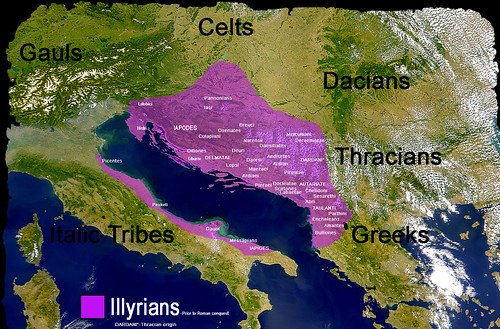
There are traces of human settlements in Bosnia dating from the Stone Age. The earliest inhabitants of Bosnia and Herzegovina of whom there is any certainty are the Illyrians, an exceedingly rapacious pastoral people who were divided into various tribes. The best known of these are: a small tribe called the Liburnians living in the northwest, who were notorious pirates; the Ardiaeans living south of the Liburnians, and the Antiariats, who were neighbours of the Ardiaeans living still farther to the south. The migrations of the Celts in the third and fourth centuries before Christ drove various Illyrian tribes out of their former possessions. From the third century until 167 B.C., a powerful Illyrian kingdom existed, under rulers called Agron, Teuta, and Genius, in southern Dalmatia, and the adjoining Herzegovina and Montenegro. The Romans had a hard struggle before they succeeded finally in breaking the power of the Illyrians and in getting control of Bosnia and Herzegovina (6 B.C.-A.D. 9). The sagacious Romans saw that in order to control the line of the Danube and the east coast of Italy it was necessary to absorb the triangular shaped country of the Illyrians. No part of the peninsula contains so many traces of Roman civilization as Dalmatia and the adjoining Bosnia. The Romans built a road from Mitrovic or Mitrovitza (Sirmium) near the Save to Gradisca and continued it from Gradisea through what is now western Bosnia or Turkish Croatia as far as Salona; they constructed a second road through upper Bosnia across the present district of Serajevo to Domavia on the Drina, and from here to Mitrovie a third road went from Salona to Narona (near Dubrawa) and to Scodra (Scutari). The Romans named the province Dalmatia after the largest and bravest of the tribes living on the coast. They divided it into three administrative dioceses, the chief cities being, respectively, Salona, the capital of the whole province, Scardona and Narenta. The northernmost part of Bosnia, extending for some distance from the Save, was included in the province of Pannonia. The Illyrians who had been familiar only with war and cattle-raising now turned their attention, under the guidance of the Romans, to mining, placer-mining for gold and agriculture. They became largely Romanized and for hundreds of years their legions bravely defended the empire.
After the fall of the Western Roman Empire Dalmatia and Pannonia came into the possession of the Ostrogoths under King Theodoric. During the war that followed (535-554) between Justinian and the Ostrogoths, the Slavs made repeated incursions into the provinces. It may be that they were called in by the Ostrogoths. After the Slavs the Avars raided the territory and in 598 turned Dalmatia almost into a wilderness. After this the Slavs greatly desired the country and sueeeeded in taking possession during the first half of the seventh century. Among the tribes which now owned the land, the Hroati (later called Croats) lived on the Dalmatic coast and the Serbi in the interior. Up to the eighth century the influence of the Byzantine Empire was paramount. At the end of the ninth century when the power of the Carlovingian dynasty extended as far as the south-eastern Alpine provinces, the Croats eame under the influence of Western civilization and embraced Latin Christianity. The tribes of the interior retained the patriarchal form of government and the old pagan worship much longer than the dwellers on the coast, notwithstanding the connection which they had had for centuries with Constantinople. Bosnia seems to have belonged to Croatia as late as the beginning of the tenth century. A little later the Servian prince Ceslav (931-960) sueeeeded in freeing Servia from the suzerainty of Bulgaria and built up a confederation of which Bosnia formed a part. About 955 Ceslav was obliged to defend the dependent banat, or district, of Bosnia (originally merely the valley of the upper Bosna) from an incursion of the Magyars. After the death of Ceslav and the dissolution of his kingdom Bosnia was ruled by native bans or chiefs. In 968 however, Bosnia was conquered by the Croatian king Kresimir and in 1019 the whole north-western part of the Balkan Peninsula came under the sway of the Eastern Roman Emperor, Basil II. After Basil's death Bosnia regained its independence and was ruled by native bans until it was united with the domain of Bela II, King of Hungary. In 1135 this ruler called himself for the first time King of Rama (Bosnia).
During the entire reign of the Emperor Manuel I Comnenus, (1143-80) a long and fierce struggle went on between the Byzantine Empire on the one side and Hungary and the southern Slavs on the other; in this Ban Boris, the first ruler of Bosnia known by name, remained faithful to Hungary. In 1163, however, Boris took sides against Stephen III in the quarrel over the succession to the Hungarian throne. He was defeated by Gottfried of Meissen who was sent with an army against him, and his family lost their power in Bosnia. The Banat of Boris extended from Livno and the valley of the Rama in the west to the Drina River in the east. Three years later Bosnia, Syrmia, Croatia, and Dalmatia became subject to the Byzantine Empire. After the death of Manuel I, Comnenus (1180) the new Ban, Kulin, was able to shake off the foreign yoke. But Bela III of Hungary, desiring to make Bosnia a dependency of his own kingdom, persuaded the pope to place the Bishopric of Bosnia and the Diocese of Ston in Herzegovina under the Archdiocese of Spalato, the territory of which belonged to Hungary. Before this Bosnia had been suffragan to Ragusa. In order to counteract this indirect Hungarian control Kulin, his family, and 10,000 Bosnians between the years 1190-99, became adherents of the Paterine heresy. When Pope Innocent III and King Emmerich of Hungary joined forces to exterminate the Paterines and to conquer Bosnia, Kulin preserved Bosnia's independence of Hungarian control by returning in 1203 to the Catholic religion in the presence of the papal legate, Johannes de Casamaris. During the reign of his successor, Ban Stephen, the Paterines grew so powerful that they deposed Stephen and substituted one of their own adherents, the able Matthias Ninoslav (1232-50), who was probably related to Kulin. In 1233 Ninoslav returned to the Catholic Faith, but notwithstanding this the land was filled with the adherents of the Paterine belief, and in 1234-39 a crusade was preached against Bosnia but was not, however, carried out. Although Ninoslav maintained his position as Ban of Bosnia, he was not able to found a dynasty and after his death his principality gradually fell to pieces. The districts of Herzegovina near Ragusa aimed at individual independence, while the rest of the territory now included in Bosnia and Herzegovina gradually came into a more complete dependence on Hungary.
During the reign of Bela IV of Hungary (1235-70) upper Bosnia and the district of Posavina were formed into the Banat of Bosnia, the region in the west on the Usora into the Banat of Usora, and the region in the east on the Drina into the Banat of Soli or Tuzla, while the western part of the present territory of Herzegovina, the region of the Rama, and southern Bosnia were ruled by various powerful Croatian families. At this time a relative of Ninoslav named Pryezda lived on the upper part of the Bosna River. Pryezda's son, Stephen Katroman (1322-53), was the first of the Katroman family from which for a century and a half came the bans and kings of Bosnia. Stephen was a vassal of the kings of Hungary, who were his relatives and members of the house of Anjou. Through this connection Stephen was able, after defeating the rulers of the present Herzegovina, to unite this territory to his domains. From the tenth century Herzegovina had formed a so-called buffer district between the Dalmatic coast and Bosnia on the one side and Servia on the other of the dismemberment of the great Servian empire of Dusan the Strong, Tvrtko, Stephen Katroman's nephew and successor, with the help of King Louis I (the Great) of Hungary, became master of the district of the upper Drina, Trebinje, and Canale. Tvrtko now, with the consent of Louis, took the title of King of Bosnia. A few years later (1384) Bosnia and Herzegovina were laid waste for the first time by the Turks. After the death of Louis the Great (1382) Tvrtko threw off the suzerainty of Hungary and conquered the cities on the Dalmatie coast. During the reigns of his successors Stephen Dabischa (1391-95), Queen Helena (1395 98), Stephen Osoja (1398-1418), Stephen Ostojitsch (1418-21), Stephen Tvrtko II (1404-31) (the rival of the two last-named kings), Stephen Thomas (1443-61), and Stephen Thomaschewitz (1461-63) the kingdom rapidly declined in power so that these rulers were not able to maintain their authority over the conquered districts or to keep the insubordinate vassals and nobles in cheek. The nobles ruled their territories with little regard for the king; they had their own courts with state officials, granted pardons, had relations with foreign powers, and carried on bloody wars with one another.
The last king, who possessed only the land on the right bank of the Bosna, sought to strengthen his position by becoming a vassal of the pope. He hoped by this means to obtain the aid of the Christian countries of Western Europe in defending himself against the threatening power of the Turks. In 1462 he refused to pay tribute to the Sultan Mohammed II; but when in the following spring Mohammed invaded Bosnia with a powerful army, the young king found himself deserted. Deceit and treason, especially on the part of the Bogomili, completed his ruin. He was taken prisoner by the Turks and beheaded, by the order of the sultan, July, 1463, probably near Jajce (Jaitza). The campaign of the Turks ended in the overthrow of the Bosnian kingdom; only Herzegovina maintained its independence. One hundred thousand prisoners of both sexes were taken; 30,000 Bosnian youths were compelled to join the janizaries. The nobility, especially the Bogomili, became Mohammedans. A large part of the remaining population left the country. The following year King Matthias Corvinus of Hungary freed from the Turkish yoke a part of Bosnia, the Banats of Jajce and Srebrenica (Srebrenitza) which belonged to Hungary until the battle of Mohacs (1526). Herzegovina came under the dominion of the Turks twenty years after the fall of Bosnia (1483). The long period of Turkish oppression is lightened by the daring feat of Prince Eugene, who in the autumn of 1697 after the battle of Zenta, with 4,000 cavalry and 2,000 infantry advanced towards the capital of Bosnia; as the expected rising of the Christian population failed to take place, he retreated carrying with him 40,000 liberated Christians. By the Treaty of Passarowitz (1718) the northern part of Bosnia and Servia was given to Austria, but the Treaty of Belgrade restored this district to the Turks.
Among the many revolts in Bosnia against the bureaucratic rule of the Osmanli Turks that of 1830-31 under Hussein Aga deserves mention of the revolts in Herzegovina that of 1875. Article 25 of the Treaty of Berlin, 13 July, 1878, granted Austria the right to occupy and govern Bosnia and Herzegovina. The main column of the Austrian troops (thirteenth army corps), under the command of General of the Ordnance Joseph Freiherr von Philoppovich crossed the Save into Bosnia near Brod 29 July; two days later Major-General Jovanovic entered Herzegovina with a division. As the occupation took place with the consent of the Porte, it was thought that there would be no fighting. But the Mohammedan population, secretly incited by Servia, rose under the leadership of the adventurer, Hadschi Loja, against the "foreign conquerors". They were joined by large bands of Arnauts from Albania and by the Turkish troops who had received no instructions The insurgents were defeated in bloody battles at Maglaj, Zepce, Jajce, Tuzla, and other places. On the evening of 18 August the Austrian troops stood before Serajevo which was taken by storm the next day. In order to hasten the end of the revolt three other Austrian army corps entered the contested district; by the end of September, 1878, both territories were subdued with the exception of a few points in the north-western part.
During Ottoman rule, many Bosnians converted from Christianity in favor of Islam. Bosnia was under Ottoman rule until 1878, when it was given to Austria-Hungary as a colony. While those living in Bosnia came under rule by the Austrian-Hungarian Empire, South Slavs in Serbia and elsewhere were calling for a South Slav state. World War I began when Serb nationalist Gavrilo Princip assassinated the Archduke Ferdinand in Sarajevo. Following the Great War, Bosnia became part of the South Slav state of Yugoslavia, only to be given to Nazi-puppet Croatia in World War II. During this period, many atrocities were committed against Jews, Serbs, and others who resisted the occupation. The Cold War saw the establishment of the Communist Federal Republic of Yugoslavia under Josip Broz Tito, and the reestablishment of Bosnia as a republic with its medieval borders within the federation of Yugoslavia.
Yugoslavia's unraveling was hastened by the rise of Slobodan Milosevic to power in 1986. Milosevic's embrace of Serb nationalism led to intrastate ethnic strife. Slovenia and Croatia both declared independence from Yugoslavia in 1991. In February 1992, the Bosnian Government held a referendum on independence. Bosnia's parliament declared the republic's independence on April 5, 1992. However, this move was opposed by Serb representatives who favored remaining in Yugoslavia. Bosnian Serbs, supported by neighboring Serbia, responded with armed resistance in an effort to partition the republic along ethnic lines to create a "greater Serbia." Full recognition of its independence by the United States and most European countries occurred on April 7, and Bosnia-Herzegovina was admitted to the United Nations on May 22, 1992.
In March 1994, Muslims and Croats in Bosnia signed an agreement creating the Federation of Bosnia and Herzegovina. This narrowed the field of warring parties down to two. The conflict continued through most of 1995, ending with the Dayton Peace Agreement being signed on November 21, 1995 (the final version was signed December 14, 1995 in Paris). Bosnia and Herzegovina today consists of two entities -- the Muslim/Croat Federation of Bosnia and Herzegovina, which is largely Bosniak and Croat, and the Republika Srpska, which is primarily Serb.